Decision Control for the Enterprise
Bring the rigor of financial modeling to business operations.
Data Sifter takes performance management from monthly and quarterly reviews into everyday decisions.
- Connect Model to Data: A formula-based metric tree mapped to your data warehouse or lake.
- Explain Variances: Automatically identify the drivers behind performance gaps so teams know where to focus.
- Align Every Team: Each team sees the drivers it controls and how they roll up to company outcomes.
Let's explore how it could work for your business.
For an online ticket marketplace like StubHub:
FROM YOUR MODEL:
Revenue = Events × Tickets per Event × Sold by Listed Tickets × Avg Ticket Price × Commission Rate
Revenue
$4.0M
Target $5M
Attainment: 80%Why did revenue miss?
Share of revenue shortfall
Why did events miss?
Share of events shortfall
One model. Same interpretation. Across every team.
The problem
Same data. Fragmented interpretation.
Teams see different pictures of performance. Those differences rarely get reconciled, so priorities diverge, decisions become disconnected, and the company loses focus on what actually drives results.
- Every team rebuilds the logic in its own dashboard, spreadsheet or AI agent.
- The same terms mean different things in Sales, Marketing, Finance and Product.
- When a number moves, everyone has an explanation. Teams move on without a shared understanding.
The solution
Your financial model, made operational.
01
Start from your model
The metrics, drivers and targets your finance team already trusts become the foundation.
02
Connect the model to live data
We map each metric to the data warehouse to automatically explain performance and variances.
03
Put the model in everyone's hands
Every team sees the drivers it controls and how they roll up to company outcomes.
For an online ticket marketplace like StubHub
Metric Tree of Formulas
Every metric is a formula of the drivers below it - so any variance traces back to the operating lever behind it.
Key entities
Slice any metric by
- Buyer
- Seller
- Listings
- Sales Transactions
- Events
- Date
- Regional Manager
From company-wide performance to the operating drivers behind every result.
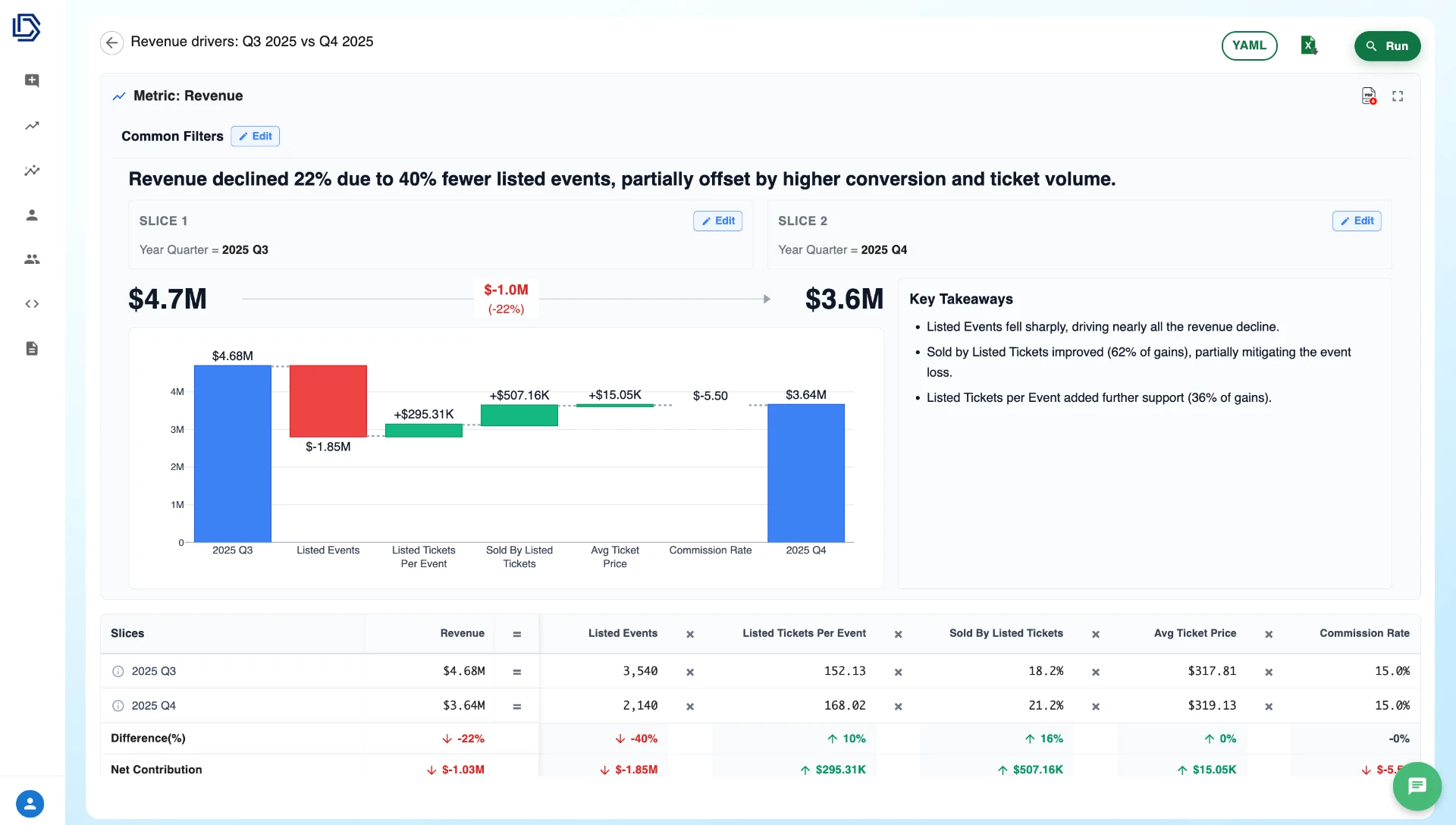
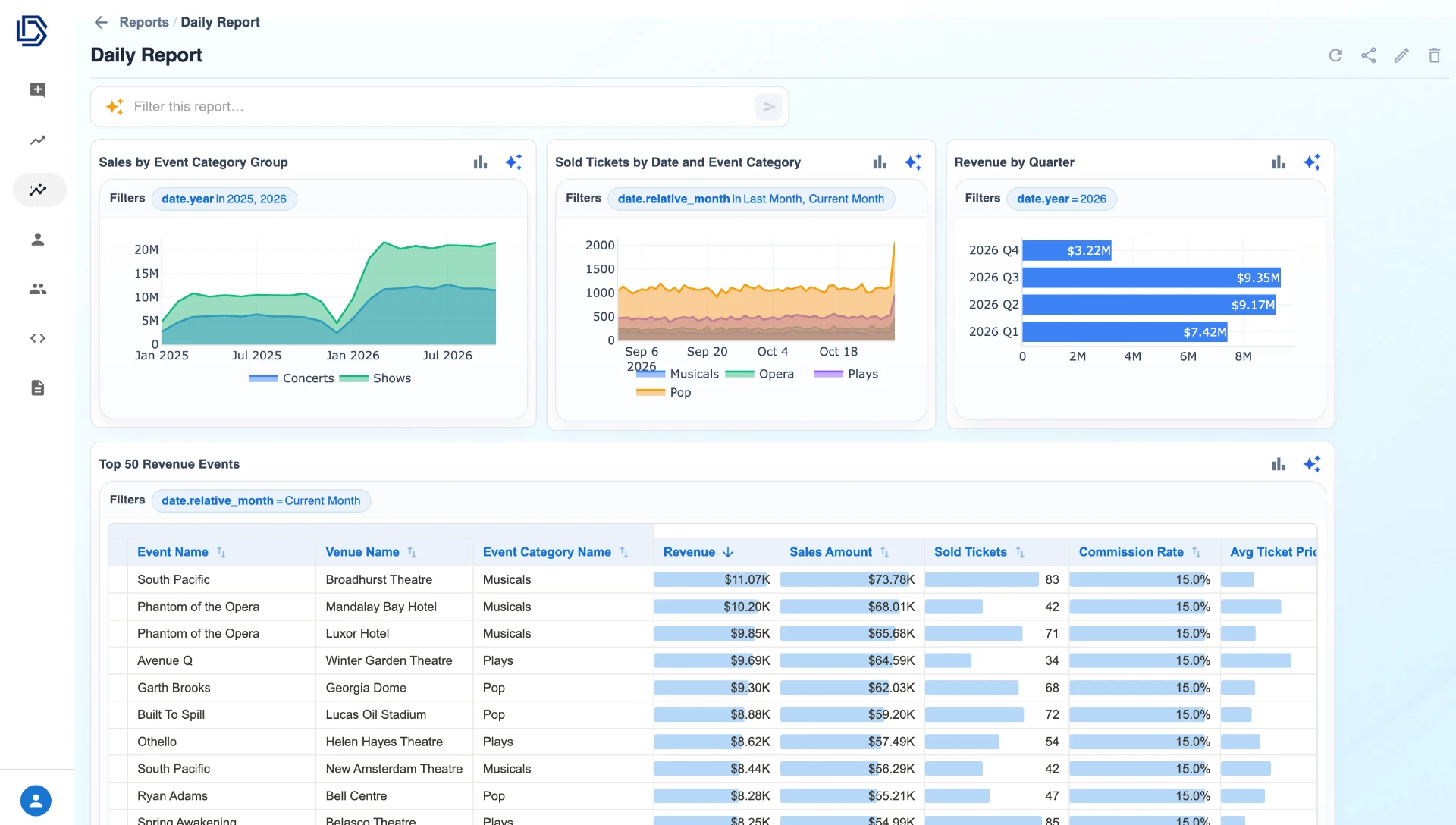
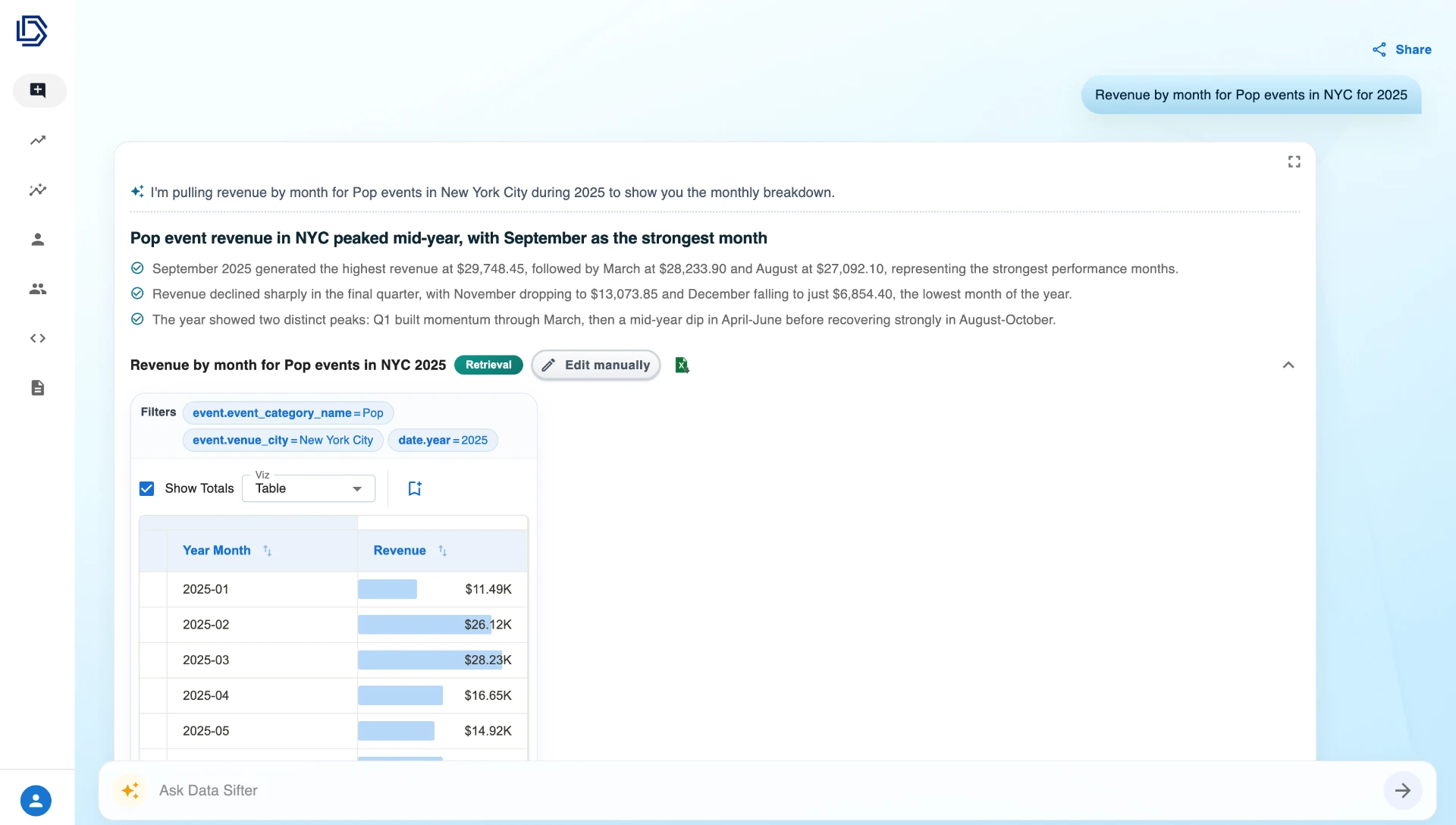
For every function
Your Metrics & Driver Formulas. One Connected Business.
Teams agree on how performance is measured, how their metrics fit together, and who owns each driver. Data Sifter turns these agreements into a shared operating model, giving every function clear accountability and the freedom to execute.
Powerful for each function. More valuable together.
Each function can use Data Sifter independently, with its own metrics, formulas, and dashboards. As functions come together, their models connect to create a shared understanding of what drives company performance.
Start seeing value in 1–2 weeks. Build from there.
Start with your most important metrics. Expand to more detail, teams, and capabilities without rebuilding or disrupting what's already working.
Let's ConnectBuilt on your existing data warehouse, with your data team owning the model.